
Quantum Optics Group
Norman Bridge Laboratory of Physics
California Institute of Technology MC 12-33
Pasadena, CA 91125
Phone: (626) 395-8342
Fax: (626) 395-1233
Norman Bridge Laboratory of Physics
California Institute of Technology MC 12-33
Pasadena, CA 91125
Phone: (626) 395-8342
Fax: (626) 395-1233
Welcome to the home page of Professor Jeff Kimble's quantum optics group at Caltech.
The primary goal of our research is to study the quantum mechanics of open systems. "Real-world" quantum mechanics takes into account the dissipation and decoherence that arise from interactions of a quantum system with its environment. In studying the role of these processes, we learn about how we might make, study, and preserve quantum superpositions and other exotic states.
You might also like to visit the sites for the Institute for Quantum Information and the Institute for Quantum Information and Matter.
Recent news
-
April 29, 2015 -Quantum matter with ultracold atoms and nanophotonic crystals:
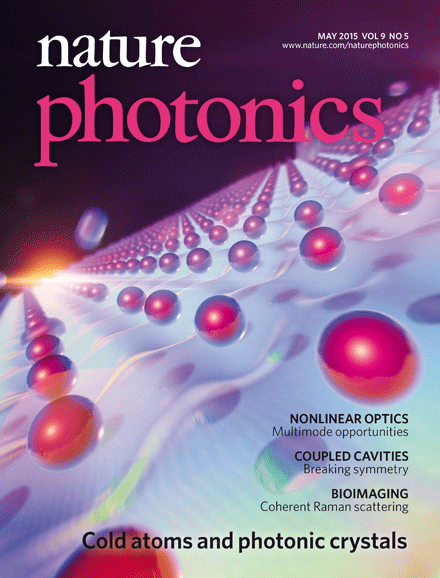 "Quantum many-body models with cold atoms coupled to photonic crystals." J. S. Douglas, H. Habibian, C.-L. Hung, A. V. Gorshkov, H. J. Kimble and D. E. Chang, Nature Photonics 9, 326-331 (2015)."Subwavelength vacuum lattices and atom—atom interactions in two-dimensional photonic crystals." A. González-Tudela, C.-L. Hung, D. E. Chang, J. I. Cirac and H. J. Kimble, Nature Photonics 9, 320-325 (2015).
Recent publications and manuscripts
(full list)