
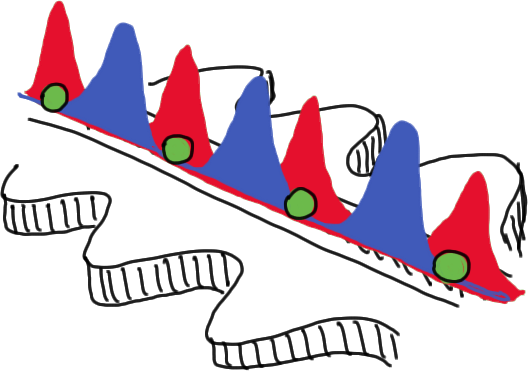
Toroidal whispering-gallery-mode optical microcavities are chip-based resonators which confine light to small volumes with extremely low losses, leading to extremely high quality factors, Q, and strong coupling, g, between the resonator and atoms. The "on-chip" design and optical fiber coupling scheme could allow integration into a quantum network. In collaboration with the Vahala research group in the Applied Physics department at Caltech, we use these micro-resonators to study the strong interaction of single Cesium atoms with single photons.
Initial experiments have demonstrated the strong coupling between a single falling Cesium atom and a single intra-cavity photon. Quantum properties of the transmitted and reflected flux of the cavity in presence of an atom have been observed.
Recent experiments have included the observation of the optical and surface forces on a Cesium atom located a couple hundred nanometers away from the toroid. After studying the trajectories of atoms falling through the surface and optical potentials, we are working towards strong coupling of optically trapped atoms to the micro-cavity.
Radiation pressure is the force that light exerts when it is reflected or absorbed. In the opto-mechanics group, we manipulate the behavior of mechanical structures with radiation pressure. This allows us to store energy in the near-lossless optical fields, and hence push the performance of micro-electro-mechanical structures (MEMS) beyond conventional material limits. The optical force can also be used to cool mechanical devices to a near zero average phonon occupancy. With opto-mechanics techniques, we hope to measure quantum phenomena in MEMS devices.
The collective effects of atomic ensembles provide a means to controllably interface light with matter. We strive to develop the physical resources necessary to enable quantum repeaters, thereby allowing entanglement-based quantum communication protocols, such as quantum cryptography or quantum teleportation, to be performed on quantum networks with distance scales much larger than the attenuation length of optical fibers.