Current Research Areas
Low-noise semiconductor lasers
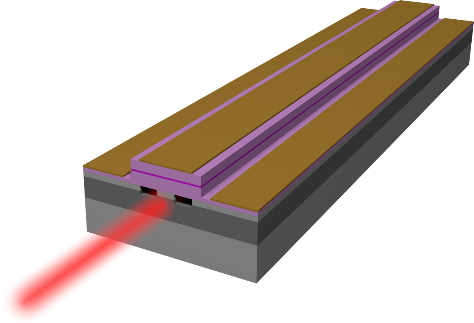 Increasing demand for high data rates is making multi-symbol coherent communication schemes an attractive alternative to the common direct modulation ones. Lasers sources for future coherent links must have higher degree of temporal coherence than current semiconductor lasers (SCLs), such as the common DFB laser. The research in our group focuses in the development of next generation’s high-Q SCLs. We have demonstrated that a novel design, in which photon-storage in a high-Q resonator is separated from electron-confinement regions, can yield several orders of magnitude improvement in noise figure. We are currently working on novel laser designs and materials that will satisfy noise requirement for coherent sources and potentially compete with the DFB laser in cost, size and power consumption. Current platforms under research in our group include
- Hybrid Si/III–V integration.
- Integration of other low-loss materials with III-V
- III-V only platforms
On-chip label-free optical bio-sensing using monolithic optical micro-resonators
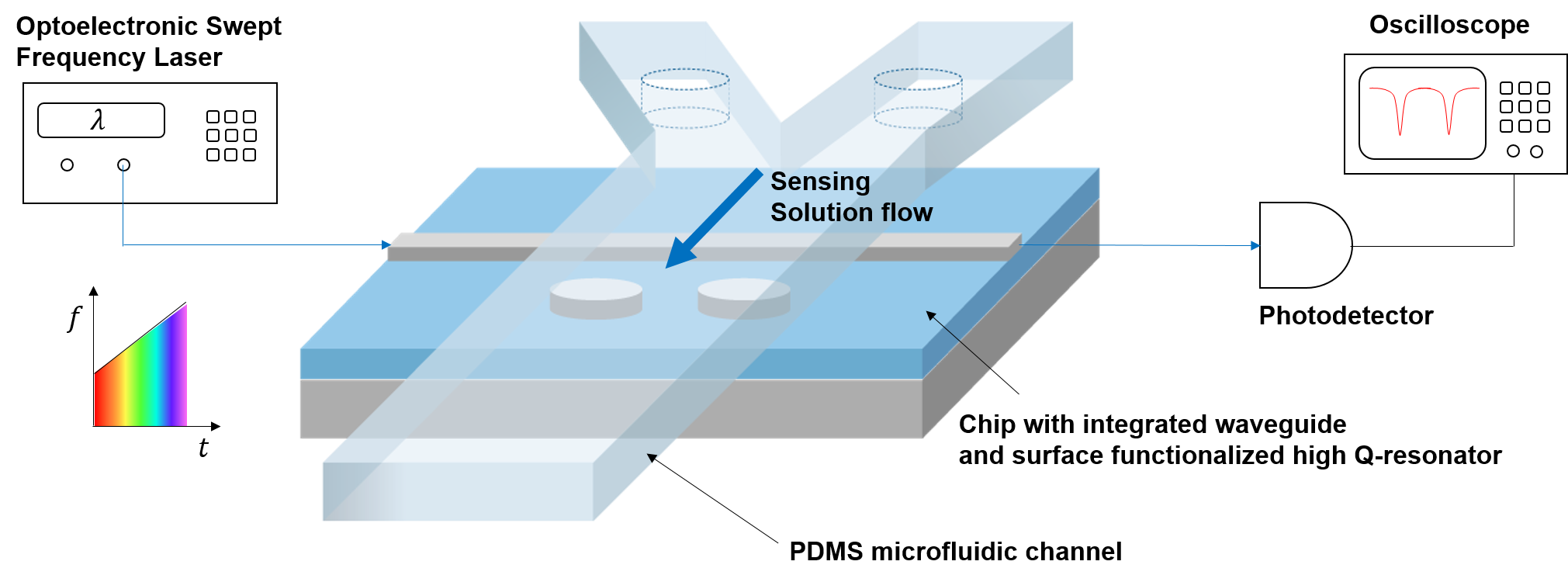
The major goal of this project is the development of a robust, versatile, and low-cost instrument that enables fast, reliable, and efficient label-free detection of biomolecules at high levels of sensitivity using the optoelectronic swept-frequency laser developed in the group. This work is highly interdisciplinary and involves collaboration with various groups to implement a fast, flexible microfluidic analyte solution delivery system and covalent surface functionalization chemistry. Currently, we are working on:
-
Implementing and characterizing the platform with the minimum limit of detection and fast sensing
- Demonstration of label-free and multiplexed bio-sensing
- Exploration of interesting bio-sensing schemes on monolithic on-chip platforms.
Optical Phase-Lock Loops
Phase-Lock Loop systems are the main enablers of many key applications in the field of RF (radio-frequency) electronics, such as wireless communications, CDMA, FM demodulation and clock recovery, to name a few. In contrast, almost all of the information applications of lasers to date have been based on a manipulation of their amplitude (Differential Phase-Shift Keying is one exception). The Semiconductor Laser is the prime candidate to play the role of the Voltage Controlled Oscillator in the optical domain. This is due to its very large current-frequency sensitivity, its fast response (>30 GHz), its small volume, and its compatibility with electronic circuits.
The research in our group focuses on the use of semiconductor lasers as current controlled oscillators in optical phase-lock systems to enable a range of diverse applications. The optical phase and frequency of the laser output is controlled by purely electronic means using RF VCOs and phase shifters, thus eliminating the need for bulky optical phase and frequency modulators. Recent and ongoing experiments have focused on the phase-locking of arrays of semiconductor lasers for many diverse applications such as coherent power combination, “coherence cloning” - where the spectral properties of a high quality laser are cloned onto a number of inexpensive semiconductor lasers, optical phase controlled apertures, and the generation of electronically controlled ultra-wideband optical waveforms.